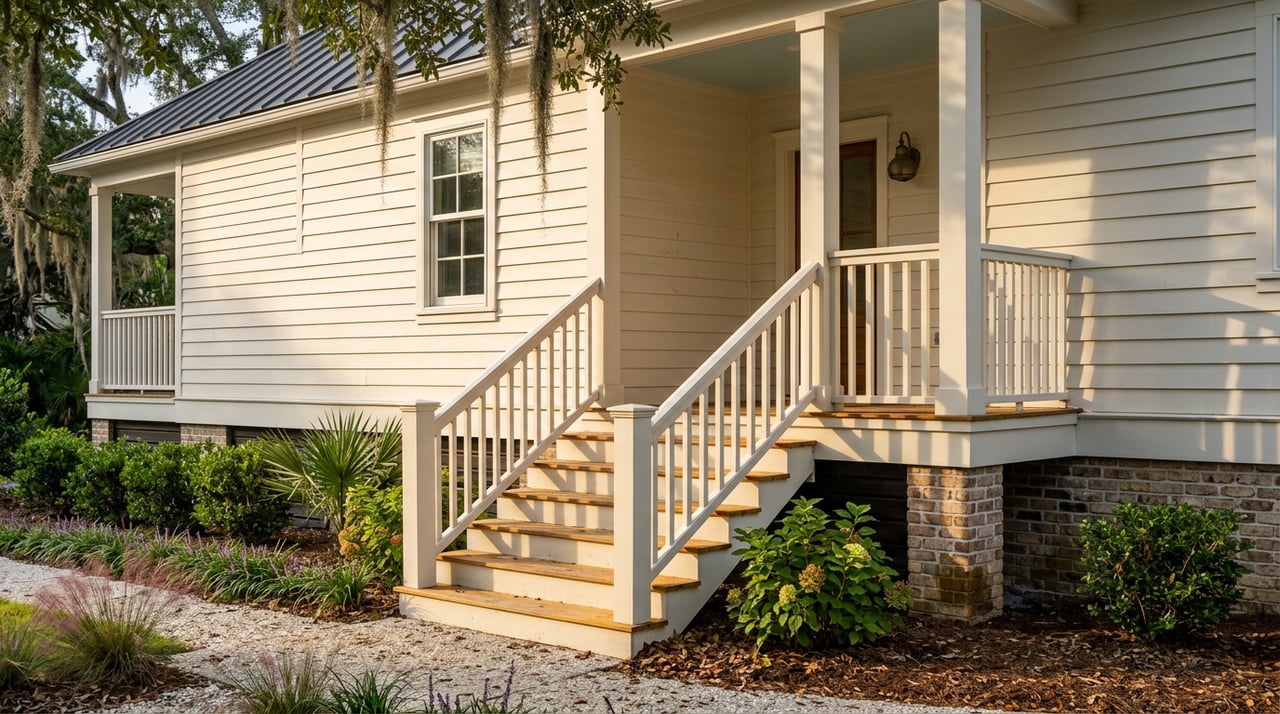
Picture two three-bedroom cottages on Tybee Island. Both asking $825,000. Both two blocks from the sand. Both raised, both renovated, both photographed at the same golden hour. One sells in three weeks. The other has been on the market for four months and just took its second price cut.
The listing photos won't tell you why. The MLS remarks might not either. The answer sits inside a single document adopted in June 2024 and a lawsuit that a Chatham County judge is still holding in his chambers.
On Tybee, the largest hidden variable in what a cottage is worth is not square footage, view, or elevation. It's whether the short-term rental permit conveys.
The rule that quietly split the island in two
Tybee froze new short-term rental permits across its R-1, R-1-B, and R-2 residential zones back in October 2022, which covers roughly 80% of the island. Then in June 2024, the previous city council passed Ordinance 08-2024, which did something more consequential than the freeze itself: it eliminated permit transferability on sale, death, or marriage. A grandfathered permit no longer moves with the deed.
That single change created two categories of cottage that look identical from the street. In the first category, the seller holds an active, transferable permit under a narrow family-transfer carve-out the current council is still debating. In the second, the seller runs a legal STR every summer, but the moment a non-family buyer signs the closing statement, the STR right evaporates.
The market has been pricing that difference for eighteen months. Buyers underwriting Tybee acquisitions this year have seen permitted cottages trade $50,000 to $150,000 above otherwise-comparable un-permitted comps. That premium is not a bidding-war artifact. It is the capitalized value of a revenue stream the ordinance now refuses to hand over with the keys.
What the headline numbers are actually saying
The Redfin snapshot for the three months ending May 2026 shows a Tybee median sale price of $730,000, up 16.7% year over year, with median price per square foot up 10.6%. On its face, that reads like a tight, appreciating market.
Read the second line. Homes are now averaging 125 days on the market, up from 66 the year before. Volume slipped as well, with 32 May sales versus 39 the year prior.
A market where price is up sixteen points and days-on-market has nearly doubled is not one market. It is two. Permitted inventory is trading briskly at a premium buyers still find rational. Un-permitted inventory is sitting, because the pool of second-home and lifestyle buyers who don't need STR income is much smaller than the pre-2024 pool, and those buyers know time is on their side. The blended median rises because the permitted trades set the high anchor, while the un-permitted overhang stretches the DOM figure.
A tale of two cottages at the same list price
| Attribute | Cottage A | Cottage B |
|---|---|---|
| List price | $825,000 | $825,000 |
| Zone | R-2 | R-2 |
| Distance to beach | 0.3 mi | 0.3 mi |
| STVR certificate held by seller | Yes | Yes |
| Certificate conveys to buyer | Yes, via family-tenant provision under current draft rules | No, per Ordinance 08-2024 |
| Buyer's Year-1 gross rental potential | Full STR revenue | 30-day-plus tenancies only |
| Effective universe of buyers | Investors + lifestyle | Lifestyle + workforce landlords |
| Typical time to contract in 2026 | Weeks | Months |
The two cottages are not the same asset. They share a photograph and diverge everywhere else that matters to a spreadsheet.
The lawsuit that could reshuffle the deck
The Tybee Alliance, a group of property owners, sued the city in January 2023 arguing that the STVR ordinance conflicts with a Georgia code section limiting local governments from requiring registration or inspection of residential rental property. Oral arguments were heard by Judge Christopher Middleton on January 7, 2026, and as of this summer the ruling is still pending.
The outcome matters to Tybee valuations in a way it doesn't to Wilmington Island or Isle of Hope. If the plaintiffs prevail on the zoning-authority question, the residential freeze likely falls, new permits reopen in R-zones, and the scarcity premium on grandfathered cottages compresses. If the city prevails, the freeze holds, the cap ordinance the council is currently drafting becomes more likely to pass, and existing permitted properties get scarcer, not less.
That cap ordinance is already public. At an April 1 workshop, council reviewed a four-sector framework proposing hard annual caps of 175 permits in Sector 1, 225 in Sector 2, 180 in Sector 3, and 180 in Sector 4. A separate May proposal from Mayor Brian West would zone the island into eastern and southern tourist sectors capped at 60% STR density with western and northern residential sectors capped at 30%. The two proposals are not identical, and the council has not settled on which one it will send to a vote. What both share is a numerical ceiling below current supply in the residential-facing sectors, which is why the outcome of either the lawsuit or the vote reprices every existing permit.
Costs that sit under the sticker price
Even when a buyer secures a conveying permit, three carry-cost items reshape the underwrite in ways the mainland doesn't touch.
The first is flood insurance. Most Tybee parcels sit in AE or VE zones on FEMA maps, and NFIP premiums on cottages there commonly run into the low thousands per year. Private-market flood is sometimes cheaper, sometimes not, and the delta between two quotes on the same address can move the cash-on-cash by a full point.
The second is the tax stack. The city collects a 7% local occupational room tax on STR revenue, remitted monthly to the finance department directly to the city rather than through the platforms. Georgia layers a 4% state sales tax and a $5-per-night state hotel-motel fee on top. Airbnb and VRBO collect the state sales tax, but the local room tax registration and monthly filing sit with the owner, and returns are required even in months with zero revenue.
The third is the 60-day proof-of-use requirement built into the current ordinance. A permit that goes unused for a full cycle can be revoked, which has already happened to inattentive owners who assumed a shoulder-season pause was harmless. A property manager who misses that clock costs the owner the asset that justified the premium in the first place.
Before you write an offer
Anyone bidding on a Tybee cottage this summer should verify, in writing, the following before the earnest money leaves escrow:
- Zoning of the parcel, confirmed through Tybee Planning & Zoning at (912) 472-5033 rather than inferred from the listing sheet.
- Whether a current STVR certificate is active on the property and, if yes, its issue date and renewal status. The city extended this year's renewal deadline to May 31, 2026, which means a lapsed permit from the last cycle may still be in a gray zone.
- Whether the seller intends to transfer the property under a provision that permits certificate transfer, and whether the buyer qualifies under any family-tenant carve-out being finalized.
- Flood zone designation and two independent insurance quotes, at least one from a coastal-Georgia broker who writes both NFIP and private.
- Homestead exemption status. An STR-operated cottage is not owner-occupied, and the loss of that exemption can shift the annual tax line meaningfully.
- HOA or condo declarations, where applicable, since some Tybee condominium regimes impose stricter rental-minimum language than the city ordinance itself.
None of these items is exotic. All of them have cost buyers real money when they were skipped.
FAQ
If the lawsuit goes the plaintiffs' way, does my permitted cottage lose value overnight? Not overnight, but the scarcity premium built into the price would likely compress as new permits reopened in residential zones. Buyers underwriting today should model both scenarios rather than pricing certainty into either.
Can I buy an un-permitted Tybee cottage and operate it as a monthly rental instead? Yes. Tenancies of 30 consecutive days or longer fall outside the STR ordinance. That path is how many buyers of un-permitted inventory are penciling their deals, generally at thinner returns than a permitted STR but with a shorter list of regulatory variables to track.
Does buying in a commercial zone avoid the freeze? Tybee's C-1 and C-2 zones are not subject to the residential freeze, and new permits are still issued there. Commercial inventory is limited, prices per unit are higher, and many of the buildings come with condominium-association layers that reintroduce their own rental rules.
The Tybee market rewards buyers who read the ordinance before they read the listing. If you are underwriting a specific cottage this summer and want a second set of eyes on the permit chain, the flood math, and the disclosure language before your due-diligence window closes, Vaden Realty Group works these files every week. Start with an instant valuation or reach out directly, and we will walk the deal with you.