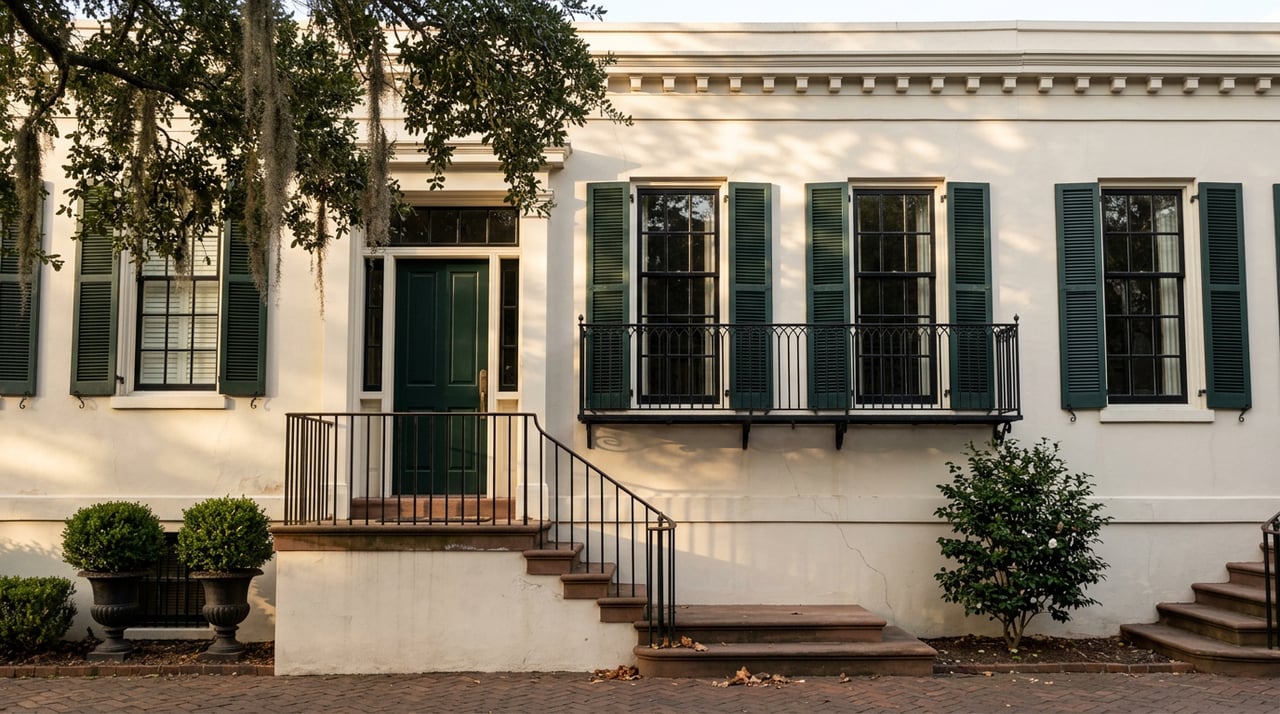
Which number do you believe: the one showing Savannah's downtown Historic District median price jumped 27 percent, or the one showing a nearly identical slice of the same district dropped almost 18 percent, both reported in 2026?
Both numbers are real. Both come from data providers who track closed sales, not asking prices. And both are describing property inside the same few dozen blocks bounded by the river, Martin Luther King Jr. Boulevard, Gwinnett Street, and East Broad Street. The contradiction isn't a data error. It's what happens when a market this small gets measured by tools built for markets ten times its size.
If you're comparing the Historic District against Ardsley Park, Midtown, or a suburban pocket further out, the sticker price is the least reliable thing you'll be handed. What actually decides whether that house is a good buy lives in two places nobody puts on a listing sheet: how thin the sales pool really is, and what happens the first time you touch the exterior.
Why the Same Streets Produce Opposite Headlines
The Savannah Business Journal reported in July 2026 that the downtown Historic District's median home price had surged past $944,000, a 27 percent year-over-year jump, and pinned it on inventory scarcity and high demand. Around the same window, Redfin's tracking of the South Historic District specifically showed March 2026 prices down 17.6 percent year-over-year to a $1.0 million median, with only nine homes sold that month, down from sixteen a year earlier, and days on market stretching to 163 from 135. Zillow's separate estimate for the same South Historic District put the average home value at $939,202, down 5.2 percent over the trailing year.
Three sources, three numbers, two directions. Here's the mechanism: none of them are measuring the same thing. The Business Journal figure covers the whole downtown Historic District as one pool. Redfin and Zillow split the district into North and South sub-areas, each with its own tiny sample. And when your monthly closing count is nine, sixteen, or fewer, a single high-dollar sale or one distressed property closing at a discount can swing the median by six figures without the underlying market moving at all.
This isn't a knock on any of these providers. It's the honest limit of median-price reporting in a district where total annual closings are measured in the dozens, not the hundreds. A citywide Savannah median, tracked across roughly 1,341 closings over a recent six-month stretch with a $359,900 midpoint, is a stable number because the sample is large. The Historic District median is not that kind of number, and treating it like one is how buyers end up either overpaying out of scarcity panic or walking away from a fairly priced house because a headline made the neighborhood look like it was cooling.
What the Board Meeting Minutes Show That the Median Can't
Here's the piece the price tag never accounts for. Buy a house in the Historic District and you've also bought a relationship with the Savannah Downtown Historic District Board of Review, a nine-member body created in 1973 that meets the second Wednesday of every month at 1 p.m. in the Arthur A. Mendonsa Hearing Room. Its job is to issue Certificates of Appropriateness for exterior work visible from a public right-of-way that requires review, and its monthly agendas are a running log of exactly what that costs owners in time.
The August 12, 2026 agenda alone included petitions for rehabilitation and alterations at 114 West Bay Street, illuminated signage at 102 West Bay Street, an awning at 107 West Broughton Street, a design amendment for a project at 620 East River Street, and a non-contributing structure determination at 15 Bull Street. Earlier in the year, the February 11, 2026 minutes recorded approval of a collapsed staircase reconstruction at 225 East President Street, an alteration at 234 Martin Luther King Jr. Boulevard, and a fence project at 314-322 West Hall Street that came with a condition attached: the rebuilt fence had to be painted or stained and signed off by staff before the file could close.
Every one of those is routine business for the board. None of them are unusual. That's the point. If you buy in this district and ever plan to replace a rotted porch rail, add a rear addition, or swap a window, you are entering that same pipeline. Local preservation guides working this process regularly are blunt that the most common reason projects get delayed is an owner assuming repair, replacement, or "you can't see it from the street" means no review is needed when it doesn't.
Windows are the clearest example. According to Henshaw Preservation, repairing an original window in the Historic District typically does not require a permit. Replacing one does, and it requires both a City building permit and a Certificate of Appropriateness from the board. That's a meaningfully different renovation budget and timeline than the same job on a house in Ardsley Park or Windsor Forest that sits outside the overlay.
What This Means Before You Write an Offer
Put those two mechanisms together and the Historic District stops looking like one market with a volatile price and starts looking like two separate costs stacked on top of each other. The first is what you pay at closing, and that number should be checked against actual recent closings on the specific block, not a district-wide median pulled from a thin monthly sample. The second is what you're implicitly agreeing to spend in time and compliant materials the first time you touch the exterior, and that cost scales with how much the house needs done and whether it's classified as a contributing structure within the district.
A few things worth confirming before you commit:
- Ask whether the property is a contributing or non-contributing structure. The Metropolitan Planning Commission says applications involving non-contributing structures go automatically to Board review.
- Ask directly whether there's any open or unresolved Certificate of Appropriateness issue.
- If your plans include a window swap, an addition, a fence, or anything visible from the street, budget for a pre-application conference with Metropolitan Planning Commission staff before you assume a timeline. City ordinance requires that conference before any application headed to a board hearing, and local preservation guides describe several weeks for small staff-level items and at least one full meeting cycle for anything requiring a hearing.
- Compare the specific block's recent closings, not the district-wide median, against the asking price. A nine-sale month can make the whole district look like it moved 20 percent in either direction when the truth is one unusual property did the moving.
None of this means the Historic District is a bad buy. Scarcity, architectural character, and a nine-member board actively protecting streetscapes are part of why these blocks hold value the way they do. It means the number on the listing is the start of the conversation, not the end of it.
If you're weighing a Historic District purchase against another Savannah neighborhood, or you own a property here and want a clear read on what your specific block is actually doing right now, Kelly Strojny and Vaden Realty Group can walk you through both the closing price and the compliance picture before you write an offer. Get Home Value to see where your property fits in this market today.
This article is general information, not legal, tax or financial advice. Consult a qualified professional about your situation.